Why Primer Doesn’t Work for Everyone: The Truth About “Photoshop” in a Bottle
It is the most hyped step in makeup tutorials. You watch an influencer squeeze a dollop of “blurring” gel onto their face, and suddenly their pores vanish. They tell you it’s essential. They tell you it’s “Velcro for your foundation.”
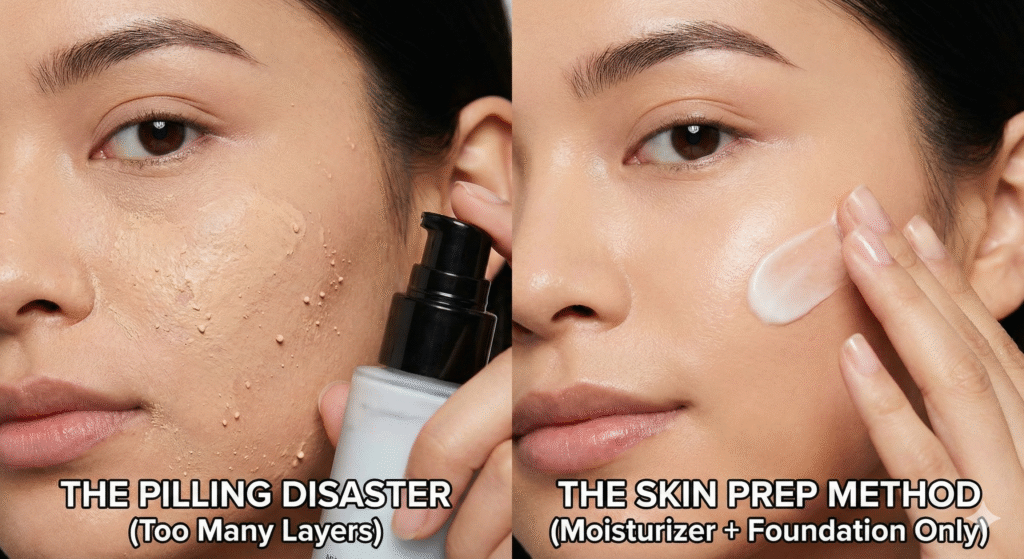
So you buy it. You apply it. And two hours later, your makeup looks… worse. It’s patchy, it’s pilling, or it’s sliding off your nose like you greased it.
You aren’t crazy. And you aren’t doing it wrong.
When we analyze why primer doesn’t work for everyone, we often find that for many skin types, primer is completely unnecessary. In fact, it often creates more problems than it solves.
The hard truth: Sometimes, your “primer” is just an expensive layer of interference between your skin and your makeup.
 Quick Answer: The 3 Reasons Primer Failed You
This is the most common reason why primer doesn’t work for everyone despite what the ads say.
The Primer Reality Check (TL;DR)
The Skincare Clash: You layered a silicone primer over a heavy oil-based moisturizer. They repelled each other.
The “Double Prep”: Your sunscreen and moisturizer are primers. Adding another layer just causes “slip.”
The Wrong Formula: You used a mattifying primer on dry skin (instant cake) or a gripping primer on textured skin (instant patchiness).
The Golden Rule: A good skincare routine is the best primer. If your skin is well-hydrated and exfoliated, your foundation will stick. Primer is a band-aid, not a cure.
1. The “Too Many Layers” Problem
Your skin can only absorb so much. Think about your morning routine: Toner, Serum, Moisturizer, Sunscreen. That is already four layers of product. When you add a fifth layer (Primer), you are asking a lot of your face. Often, the primer just sits on top of the sunscreen, never settling. When you try to blend foundation over it, the whole mess rolls up into little balls (pilling).
Elite Insight: Professional Makeup Artists often skip primer entirely on clients with great skin. They just use a rich moisturizer and massage it in until it gets “tacky.” That tackiness is the grip you are looking for.
2. When Primer Doesn’t Work for Everyone: Skin Type Breakdown
We talked about this with foundation separation, but it applies here too. Most popular primers are silicone-based (Dimethicone) because they fill pores.
The Science: Silicone-based primers use film-forming agents like dimethicone, which create a smooth barrier but can prevent water-based products from bonding properly.
If your foundation is water-based (runny and hydrating), it will physically slide off that silicone barrier. It’s like trying to paint water onto a greased pan.
The Fix: Check your ingredients. If your foundation is water-based, your primer must be water-based too. Or, better yet—skip the primer and let the foundation sink into your skin.
3. The “Texture” Myth
Primers claim to fill pores and smooth texture. And they do… for about an hour. But as your face moves (talking, smiling), the “filler” in the primer shifts. By noon, that “smooth” layer has cracked, and your texture looks more emphasized than before.
The Reality: Texture is normal. Pores are normal. Trying to spackle over them with thick silicone often draws more attention to them because the makeup collects in the “cracks.”
4. When Primer Actually Makes Sense
We aren’t saying primer is useless. It is a tool, and like any tool, it has a specific job. Here is when you should use it:
-
Extremely Oily Skin in Humid Climates: If your oil breaks through foundation in 1 hour, a mattifying primer acts as a necessary shield.
-
Bridal Makeup (12+ Hours): When you need makeup to last through tears, sweat, and dancing, a gripping primer is insurance.
-
Stage or Flash Photography: Harsh lights emphasize texture; blurring primers help diffuse that light.
-
Large Visible Pores with Matte Foundation: Matte formulas can sink into pores; a silicone primer creates a smooth bridge over them.