

Why Vitamin C Oxidizes: The “Orange Serum” Reality Check
It is a heartbreak every skincare enthusiast knows. You splurge $80 on a high-end Vitamin C serum. You use it three times. You forget about it for a month. When you open it again, that crystal-clear liquid has turned into a dark, rusty orange sludge. It smells slightly like hot dog water.
You wonder: Can I still use this? Is it stronger now because it’s darker?
The answer is a hard no.
And no — using oxidized vitamin C will not “boost” results or speed up brightening.
To understand why vitamin C oxidizes, we have to look at simple chemistry. Pure Vitamin C (L-Ascorbic Acid) is the most unstable ingredient in skincare. It is desperate to donate electrons. The moment it touches air, light, or heat, it sacrifices itself to neutralize them. The “orange” color isn’t potency; it is simply the byproduct of that chemical reaction.
 Quick Answer: Why Vitamin C Oxidizes & The Safety Guide
Before you put that dropper on your face, hold the bottle up to natural light.
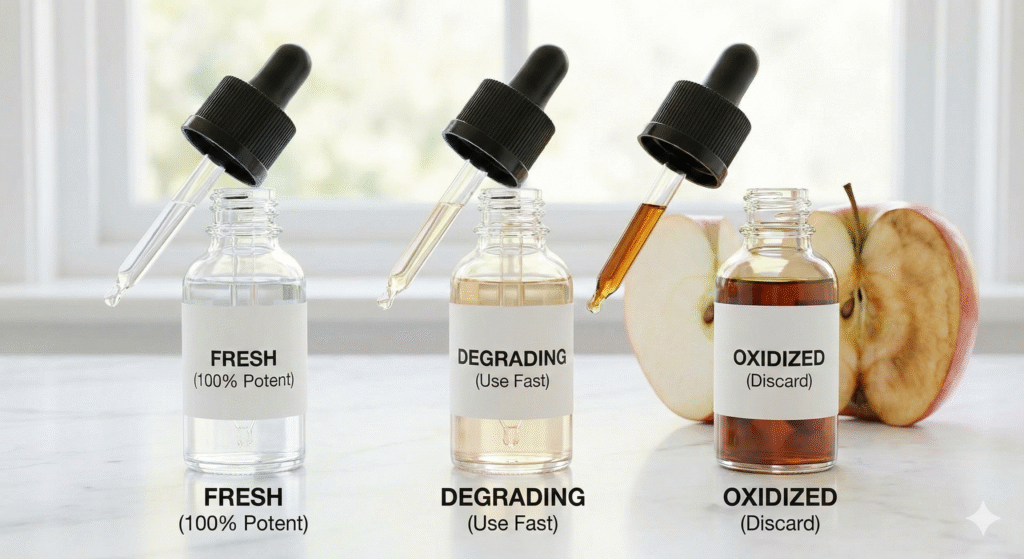
The Oxidation Spectrum (TL;DR)
Clear to Pale Straw:
Fresh. (100% Potency). Use freely.
Champagne / Light Yellow:
Warning. (80% Potency). It has started to degrade. Use it up fast (on neck and chest too).
Dark Orange / Brown:
Fully oxidized. Potency lost. It may irritate skin and is best discarded.
 Instant Decision Guide: Is Your Bottle Designed to Fail?
-
Clear Glass Bottle + Dropper? → High Risk (UV light degrades it quickly).
-
Dark Amber Bottle + Dropper? → Medium Risk (Air enters every time you open it).
-
Opaque Airless Pump? → Low Risk (The gold standard for stability).
 The Preservation Protocol (Stop the Rot)
You can’t stop oxidation, but you can slow it down significantly.
-
The Fridge Rule: Cold temperatures slow down chemical reactions. Keep your Vit C next to your butter, not your shower.
-
The “Tight Cap” Drill: Oxygen is the enemy. Close the bottle immediately after dispensing.
-
The 3-Month Clock: Mark the date you opened the bottle. If you haven’t finished it in 90 days, toss it.
1. The “Sliced Apple” Science
Why does Vitamin C turn brown? Think of a sliced apple left on the counter. Within 30 minutes, the white flesh turns brown. This is oxidation. L-Ascorbic Acid is an antioxidant. Its job is to “take a bullet” for your skin cells. It catches free radicals (unstable molecules) and neutralizes them. However, inside the bottle, it fights oxygen from the air. When it loses the battle, it breaks down into Erythrulose.
Fun Fact: Erythrulose is a primary ingredient in fake tanners. If you use oxidized Vitamin C, you aren’t brightening your skin; you are literally staining it orange.
2. The Danger of “Pro-Oxidants”
This is the part brands don’t tell you. When Vitamin C oxidizes, it doesn’t just become ineffective; it can become harmful. It transforms from an anti-oxidant into a pro-oxidant.
Cosmetic Chemist Insight: Instead of fighting free radicals, oxidized Vitamin C generates them. Applying brown serum can actually cause inflammation and cellular stress—the exact opposite of the anti-aging effect you paid for.
Elite Insight: If your skin stings or feels itchy immediately after using an old serum, it’s not “working”—it’s irritating your barrier. (Read our guide on [[Why skin itches without allergy]] to distinguish between active tingling and barrier damage).
3. The “Waterless” Workaround
Because L-Ascorbic Acid degrades in water, modern science has found a loophole: Anhydrous (Water-Free) Formulas. These use silicones or oils to suspend the Vitamin C. Because there is no water, the oxidation clock doesn’t start until the product touches your skin. The Trade-off: They often feel greasy or gritty compared to the watery serums we love, but they last for years on the shelf.
 Do NOT Do This With Vitamin C
 Do NOT buy “Clear Bottle” Vitamin C. (Brands do this to show off the texture, but UV light destroys the molecule in days. It is a design flaw, not a feature). Do NOT stock up during sales. (Vitamin C has a shelf life even when sealed. Buy one, finish it, then buy another). Do NOT mix with Copper Peptides. (Copper accelerates the oxidation of Vitamin C rapidly in the same routine).
Why: You are fighting chemistry, and chemistry always wins.
 The Oxidation Color Guide
File Name: vitamin-c-oxidation-color-chart.jpg Alt Text: Why vitamin C oxidizes – color stages from fresh to brown serum Caption: Stop using it when it hits the middle stage. By the time it looks like tea, it belongs in the trash.
Real-Life Micro-Story: The “Glow” That Wasn’t
“I loved my Vitamin C serum. I thought it was giving me a ‘golden glow.’ I used it every morning for 6 months. Then I went to get a facial, and the aesthetician scrubbed my face. The ‘glow’ came off on the towel. It was orange oxidation stain. I had been walking around with a rusty face layer for weeks thinking it was radiance.”
The Lesson: Real radiance comes from healthy skin cells, not surface staining.
Final Thoughts: Freshness is Potency
In the world of Vitamin C, freshness is more important than percentage. A fresh 10% serum is infinitely better than an oxidized 20% serum.
Understanding why vitamin C oxidizes saves you money and saves your face. Treat your serum like fresh juice—drink it up (metaphorically) while it’s fresh, or discard it.
If your skin feels sensitive or raw after using strong actives, you may need to pause and repair. (Read our step-by-step guide on [[How to fix a damaged skin barrier]]).
The best Vitamin C serum is the one you finish fast.
Frequently Asked Questions
Q: Can I put oxidized Vitamin C on my body? A: No. It is a pro-oxidant. It can cause irritation on your legs just as easily as your face. If it’s brown, pour it down the drain.
Q: Why does my Vitamin C smell like coins or hot dogs? A: That is the natural scent of Ferulic Acid, which is often added to stabilize Vitamin C. A metallic smell is normal; a rancid or sour smell is not.
Q: Does the refrigerator really help? A: Yes. Published stability studies on L-Ascorbic Acid show that refrigeration (around 4°C) can slow oxidation rates by up to 4–5× compared to room temperature.
