

Night Routine for Repair: The “Sleep Mode” Skin Reset Guide
During the day, your skin acts as a shield against UV rays and pollution. But the moment you sleep, the shift changes. Your skin enters “Repair Mode.”
Blood flow increases, cell mitosis (division) peaks, and the skin works to undo the oxidative stress sustained during the day. If you are just washing your face and hoping for the best, you are missing the most critical window for improvement.
The goal of a night routine isn’t just to clean; it is to support this biological repair process.
To understand the perfect night routine for repair, we have to respect your skin’s circadian rhythm. Dermatology research shows that skin permeability is higher at night. This allows ingredients to penetrate deeper, but it also means your skin loses more moisture—a process known as Transepidermal Water Loss (TEWL). Your routine must balance high-performance actives with barrier-supporting hydration to counteract this loss.
 Quick Answer: The “Repair Sandwich” Method
A repair routine needs three specific layers to function correctly.
The P.M. Hierarchy (TL;DR)
Layer 1: The Canvas (Double Cleanse). You cannot repair dirty skin. Thoroughly removing sunscreen and debris is the prerequisite for absorption.
Layer 2: The Active (Treatment). Retinoids or Peptides. These signal the cells to accelerate turnover and collagen production.
Layer 3: The Seal (Occlusives). Ceramides or heavy creams. These lock hydration in to prevent TEWL overnight.
 Instant Decision Guide: Which “Active” Do You Need?
-
Acne or Texture issues? → Retinoids (Retinol/Adapalene). (Accelerates cell turnover).
-
Dullness or Dark Spots? → Glycolic/Lactic Acid. (Dissolves dead surface cells).
-
Sensitive or Damaged Barrier? → Peptides & Centella. (Supports repair without irritation).
-
Note: Avoid using Retinoids and Exfoliating Acids on the same night to prevent barrier damage. Cycle them (e.g., Retinol on Mon/Wed, Acid on Fri).
1. Step One: The “Double Cleanse” (Non-Negotiable)
Most people fail here. They use a gentle wash and assume the day is gone. The Truth: Water-based cleansers cannot effectively dissolve oil-based debris like sunscreen, silicone primers, and excess sebum. If you skip this, your expensive serum may sit on top of a microscopic layer of residue. The Fix:
-
Oil Cleanse/Balm: Massage into dry skin for 60 seconds to break down lipids.
-
Water Cleanse: Follow with a gentle gel or cream cleanser to wash away the emulsified oil.
2. Step Two: The “Cellular Signal” (Retinoids)
Retinoids (Vitamin A) are widely considered the gold standard in dermatology for improving cell turnover and long-term skin renewal. They act as cell communicators, signaling older cells to behave like younger, healthier cells.
Dermatologist Insight: You don’t need high percentages to see results. A pea-sized amount of 0.3% Retinol is often sufficient. Dermatologists often emphasize barrier repair and gradual retinoid use to minimize irritation while maximizing long-term results.
 Safety Note: If you are pregnant, breastfeeding, or have active skin conditions like eczema or rosacea, consult a dermatologist before using retinoids. Bakuchiol is often a safer alternative.
(If you are using Vitamin C in the morning, Retinol is its perfect partner at night. Read our guide on [[Why Vitamin C Oxidizes]] to ensure your morning serum is actually working).
3. Step Three: The “Great Seal” (Moisture)
Because TEWL increases at night, your skin is prone to dehydration. A lightweight lotion often isn’t enough to hold water until morning. For true repair, look for barrier-identical ingredients: Ceramides, Cholesterol, and Fatty Acids. These mimic your skin’s natural lipid matrix.
The “Slugging” Method: For very dry skin, applying a thin layer of an occlusive (like petrolatum) over your moisturizer can significantly reduce overnight water loss by forming a protective seal. This forces hydration back into the stratum corneum.
 Adjust Based on Skin Type
Skincare is not one-size-fits-all. Customize your “Seal” based on your needs:
-
Oily / Acne-Prone: Use lightweight gel-creams containing Niacinamide. Avoid heavy slugging, as it can trap heat and bacteria.
-
Dry / Dehydrated: Use rich creams with Shea Butter or Ceramides. Consider slugging 2-3 times a week.
-
Sensitive: Stick to basic, fragrance-free moisturizers. Start Retinol slowly (1-2 times per week) using the “sandwich method” (moisturizer > retinol > moisturizer).
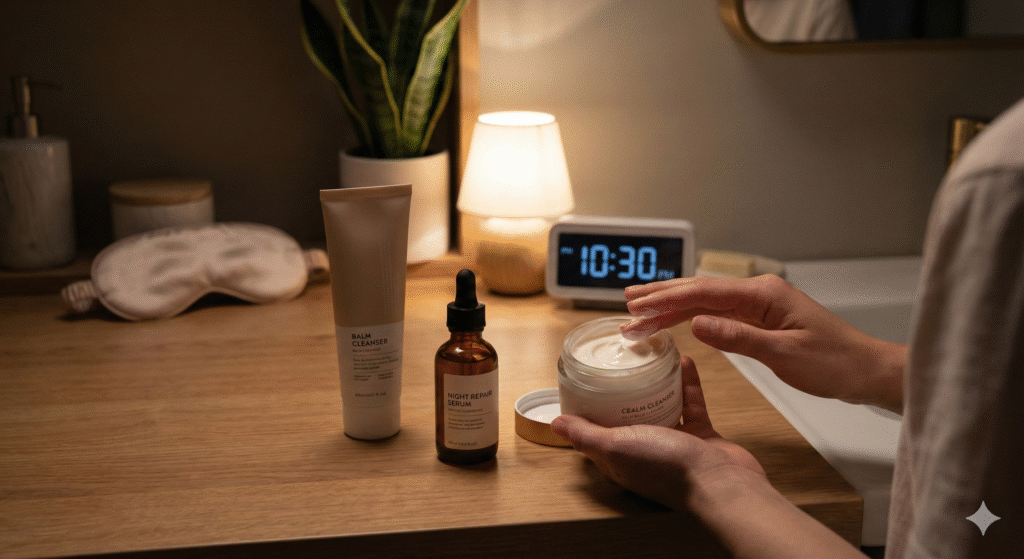
 Do NOT Do This At Night
 Do NOT apply Retinol to damp skin. (Damp skin is more permeable, which can cause the active ingredient to penetrate too quickly, leading to irritation burns. Always wait for skin to dry). Do NOT skip the neck. (The skin on your neck is thinner and produces less oil, making it faster to show age. Extend your routine down to your chest). Do NOT sleep on cotton pillowcases. (Cotton is absorbent and can pull moisture and product from your face. Silk or satin is less absorbent and gentler on the skin).
Why: To maximize efficacy, the product should remain on your skin, not transfer to your bedding.
 The “Skin Clock” Visual
File Name: skin-circadian-rhythm-chart.jpg Alt Text: Night routine for repair – chart showing skin cell mitosis peaking at night vs protection during day Caption: Your skin works the night shift. While you sleep, cell division and repair processes peak, making it the critical time for active ingredients.
Real-Life Micro-Story: The “Over-Exfoliator”
“I used to think ‘repair’ meant scrubbing. I used an acid toner every night. My skin looked shiny but felt tight and sensitized. I switched to a barrier-focused night routine: Oil cleansing, gentle Retinol twice a week, and a thick ceramide cream. Within a month, the chronic redness subsided and my skin felt resilient rather than stripped. I learned that a repaired barrier reflects light better than an exfoliated one.”
The Lesson: Healthy skin is hydrated skin, not just exfoliated skin.
Final Thoughts: Consistency Compounds
Repair doesn’t happen in one night. Skin cell turnover typically follows a ~28-day cycle in healthy adults, which is why consistency matters more than intensity.
Understanding a night routine for repair changes your mindset from “cleaning” to “rebuilding.” Give your skin the raw materials it needs, aim for 7-8 hours of sleep, and let your biology do the rest.
If your skin stings when you apply moisturizer, your barrier may be compromised. (Read our step-by-step guide on [[How to fix a damaged skin barrier]] before introducing strong actives).
Sleep well. Your skin is counting on it.
Frequently Asked Questions
Q: Can I use Vitamin C at night? A: Yes, you can. However, most dermatologists recommend Vitamin C in the morning (for antioxidant protection against UV/pollution) and Retinol at night (for repair). Separating them reduces the risk of irritation.
Q: How long should I wait between steps? A: Precise timing isn’t critical, but letting your Retinol absorb for 5-10 minutes before applying heavy cream ensures it has time to interact with the skin cells without being immediately diluted.
Q: Is “Slugging” safe for acne-prone skin? A: Proceed with caution. While petrolatum itself is non-comedogenic (won’t clog pores), it creates an impermeable seal that traps everything underneath it—including bacteria, sweat, and oil. If you have active acne, a breathable barrier cream is often safer than pure Vaseline.